
News
Padel vs tennis: the differences on court and for your venue
Court, walls, net, serve, scoring and rackets compared from the official rules of both sports, and what the difference means for the space a venue needs.
Published · Updated
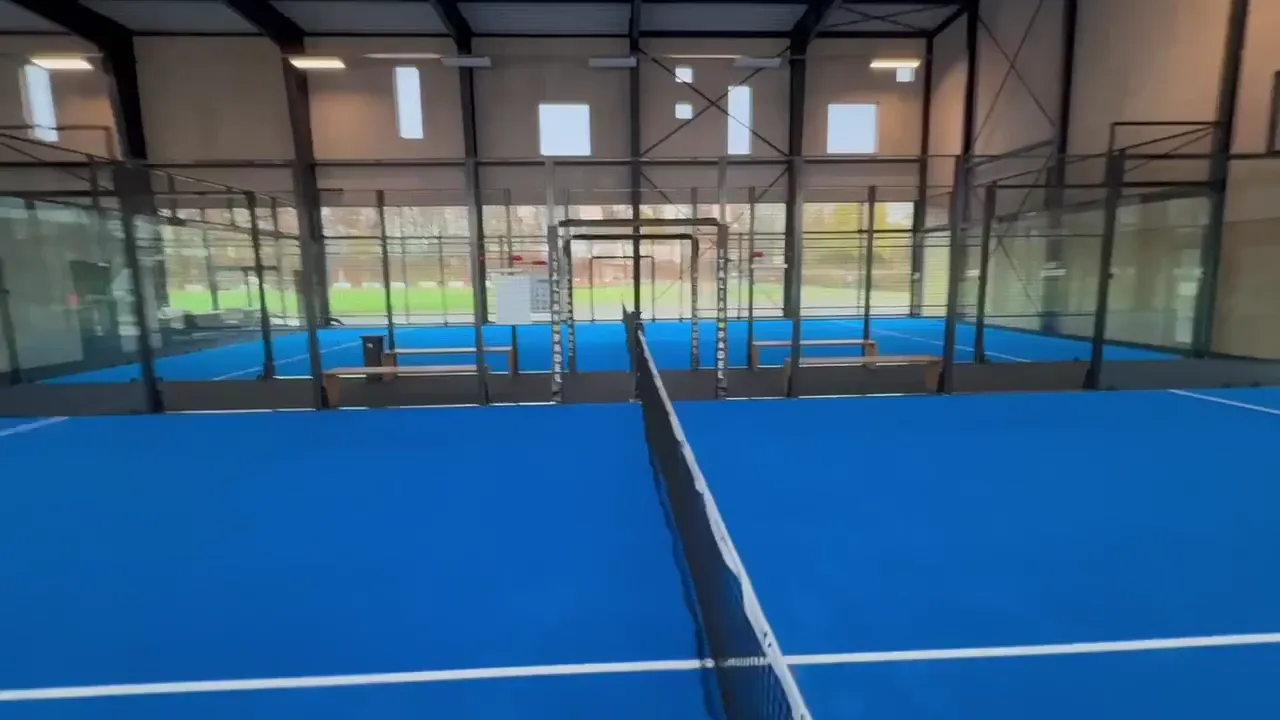
Padel takes its scoring from tennis, but the court, the walls, the serve and the racket are all different, and so is the space a court takes up. Here are the differences, from the 2026 rules of both sports: the ITF Rules of Tennis and the FIP Rules of Padel.
A smaller court, closed in by walls
A tennis court is 23.77 m long and 10.97 m wide for doubles, or 8.23 m wide for singles. A padel court measures 20 × 10 m inside its walls, a playing area of 200 m² against about 261 m² for tennis doubles.
The bigger gap is around the court. Laid out with its run-off, a tennis court takes an area of 36.58 × 18.29 m, almost 670 m². A padel court needs no run-off behind the baseline, because the walls are the boundary. That is why one tennis plot holds one double and one single padel court, or three doubles if it is at least 20.8 m wide.
In padel the walls are part of the game
A padel court is enclosed: the end walls are 3 m of glass topped by 1 m of metal mesh, and the sides are glass and mesh as well. Once the ball has bounced in your half, it stays in play when it hits a wall or the mesh, and you can still return it as long as it has not bounced twice. You can even play it against your own wall so it carries over the net. In tennis, a ball that lands in court and then hits the fence wins the point for the player who hit it.
A slightly lower net
The tennis net is 0.914 m high at the centre and 1.07 m at the posts. The padel net is 0.88 m at the centre and 0.92 m at the ends.
An underarm serve
In tennis the server releases the ball by hand and hits it before it touches the ground. In padel the server bounces the ball first and hits it at or below waist height, with at least one foot on the ground. In both sports the serve goes diagonally into the opposite service box, and a fault on the first serve leaves a second one.
The same scoring, with a deciding point
Padel keeps tennis scoring: 15, 30, 40 and game, sets to six games with a tie-break at 6–6, and matches over the best of three sets. Both sports also allow a single deciding point at deuce instead of advantage: the No-Ad method in tennis and the golden point in padel. Padel adds a third option, the star point, where the game is decided by one point if it reaches deuce for the third time.
A solid racket, and always in pairs
A padel racket has no strings. Its hitting surface is solid and perforated with holes, and the racket may be at most 45.5 cm long, against 73.7 cm for a tennis racket. Padel is played in pairs: the rules are written for two pairs of players, while tennis has singles and doubles. Single padel courts of 20 × 6 m are built for one-on-one play, lessons and narrow sites.
What it means for a venue
For a club or a facility owner the difference is mostly space and use. Four players share a 200 m² court, and the plot that holds one tennis court can hold up to three padel courts. Padel is easy to pick up for all ages and levels, and enclosed or indoor courts can be played all year round.
At a glance
- Court: padel 20 × 10 m; tennis 23.77 × 10.97 m for doubles
- Space: padel needs no run-off; tennis is laid out on 36.58 × 18.29 m
- Walls: part of play in padel; none in tennis
- Net at the centre: padel 0.88 m; tennis 0.914 m
- Serve: in padel underarm, after a bounce; in tennis before the ball touches the ground
- Scoring: the same 15–30–40 system, with a deciding-point option in both
- Racket: padel solid and perforated, at most 45.5 cm; tennis at most 73.7 cm
- Players: padel in pairs; tennis singles or doubles
Thinking of adding padel next to tennis, or instead of it? Read our guide to converting a tennis court, or send us your site plan with a quote request.